Cyprus–Lebanon: The Undersea Cable That Could Reshape Regional Energy
Cyprus and Lebanon have asked the World Bank to assess an undersea electricity interconnection. Here is why it could turn Cyprus into a regional energy hub.
A new chapter is opening in the Eastern Mediterranean's energy map and Cyprus is at its centre.
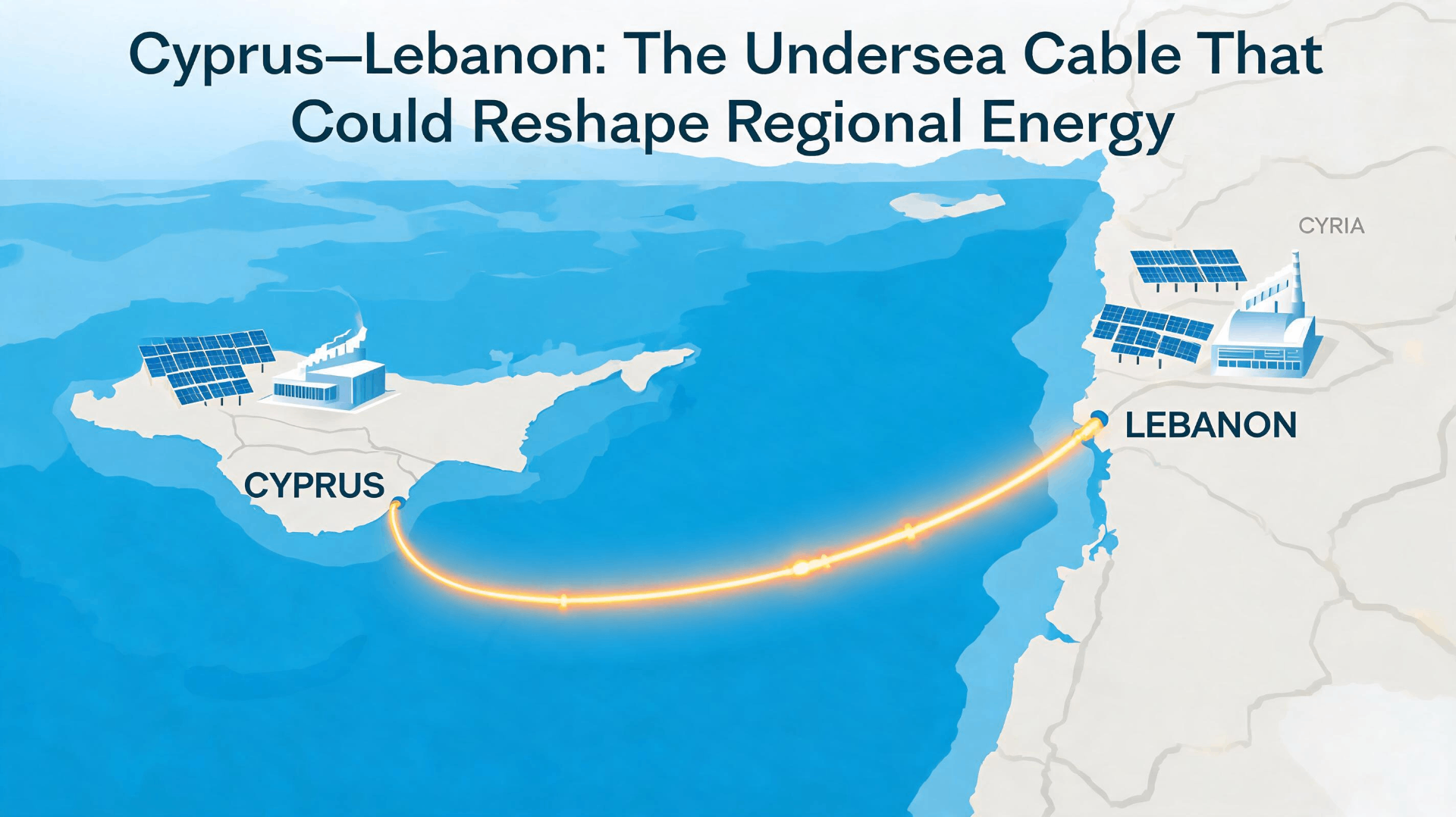
On 19 July 2026, Lebanese Energy Minister Joseph Al Saddi confirmed that Cyprus and Lebanon have jointly requested the World Bank to assess the feasibility of an undersea electricity interconnection between the two countries.
This is not just another infrastructure project. It is something much larger.
Why does this project matter strategically?
If Cyprus connects electrically to Lebanon, and if the planned Great Sea Interconnector linking Cyprus to Greece and the broader European grid is completed, then Lebanon gains access to the European electricity network through Cyprus.
Cyprus transforms from an energy-isolated island into a regional energy distribution hub for the Eastern Mediterranean.
What we know so far
- The World Bank will finance the feasibility study, structured in two phases.
- Phase 1 (~6 months): Examines economic viability: supply, demand, and cost.
- Phase 2: Detailed technical and financial assessment, if Phase 1 is positive.
- A joint technical committee and steering committee have already been established between the two governments.
- Project financing could come from private investors or international institutions, including the European Commission.
What does this mean for you today?
If you own a solar system, or are considering one, Cyprus's energy independence is the framework within which every renewable energy investment operates.
An electrically isolated island, as Cyprus is today, faces structural limits: the inability to export or import electricity is precisely why we see solar curtailments during winter and spring. Interconnections, with Lebanon, Greece, and Europe, solve this problem at the root.
The road ahead
A feasibility study does not mean the cable will be built tomorrow. Financing remains the major challenge, and timelines depend on Phase 1 results.
What is clear: Cyprus is on a trajectory of fundamental energy transformation; battery storage, interconnections, renewables. And these are not wishes. They are signed contracts, official studies, ministerial statements.
Our question to you
Do you believe Cyprus can evolve into an energy hub for the Eastern Mediterranean? Or are the geopolitical obstacles larger than they appear?